
What would Dante Alighieri make of the Nvidia debacle?
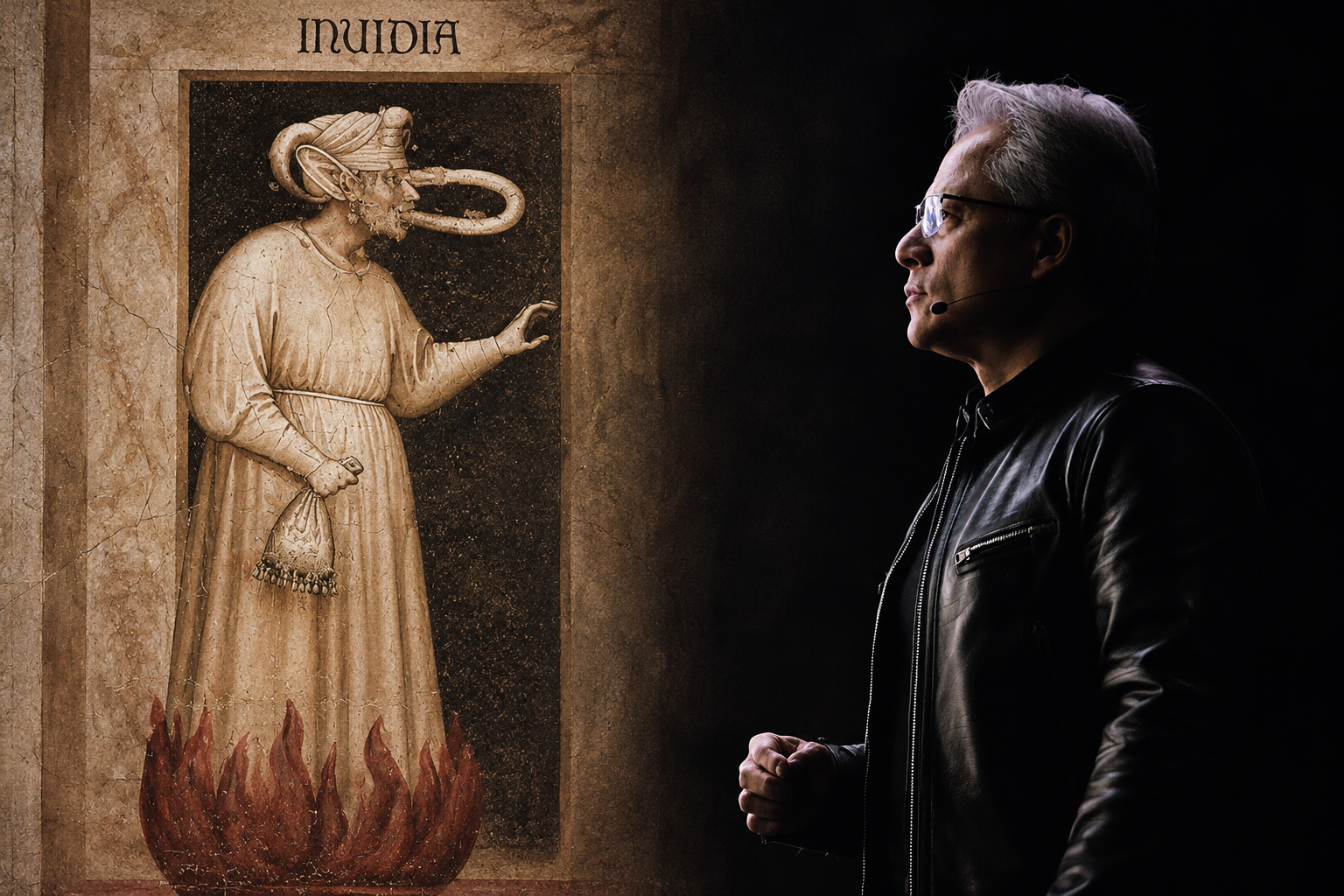
AI-assisted editorial illustration depicting Giotto’s Invidia juxtaposed with a photo of Nvidia CEO Jensen Huang in a black leather jacket
A note to readers: The author is neither a classics scholar nor a Latinist, and their acquaintance with Dante is that of an interested amateur. Corrections from those better acquainted with the poet, his language, or his afterlife are welcome.
***
The Italian poet Dante Alighieri (1265–1321) had a considerable interest in the misconduct of important people. In The Divine Comedy, his account of an imagined journey through Hell, Purgatory and Heaven, he encounters emperors, popes, merchants, lovers and a gratifying number of his political enemies. Some had been dead for centuries; others were figures his readers would have recognized from the news, if they had newspapers. Dante was concerned with the eternal condition of the human soul, but he was not indifferent to the goings-on in Florence.
One suspects he would have found Silicon Valley similarly absorbing.
Consider Nvidia, whose chips have helped make the artificial intelligence boom possible and whose cofounder, Jensen Huang, has acquired the kind of celebrity once reserved for people who appeared on screens rather than supplied the technology behind them. Huang's recent departure and return as chief executive presented investors with a question of considerable financial consequence: What was Nvidia worth without him? It also presented a rather older question: What allowances can powerful people expect from those who depend on them?
Dante had an elaborate framework for considering human failings. His Hell is divided into nine circles, where the damned suffer punishments fitted to their sins. Purgatory is a different proposition. Its inhabitants are destined for Heaven, but first they must ascend a mountain whose seven terraces correspond to the seven deadly sins: pride, envy, wrath, sloth, greed, gluttony and lust. Their sufferings are intended to correct their failings. In Hell, it is too late to repent. In Purgatory, there is still work to be done.
In Nvidia's case, Dante might have begun with the name.
What's in a Name?
When Huang and his cofounders were developing their first graphics chip in 1993, they used NV, short for “next version,” in their filenames. As Huang later explained to Fortune, when choosing a name for their fledgling company they looked for a name incorporating those letters and settled on invidia, the Latin word for envy (!!!) and one of the seven deadly sins explored in The Divine Comedy.
Invidia survives unchanged in modern Italian. The Latin verb invidere means to regard someone with envy or ill will — or, as Lewis & Short's Latin dictionary puts it, “to cast an evil eye upon.” Across the ancient Mediterranean, people feared that another person's envious gaze could bring misfortune upon its object. The belief survives in the Italian malocchio, or evil eye.
Around 1305, the Italian painter Giotto depicted Invidia in the Scrovegni Chapel in Padua as a woman clutching a purse, with a serpent emerging from her mouth and turning back to strike at her eyes. Envy, in Giotto's telling, carries the instrument of her own undoing.
As if naming one's company after a deadly sin weren't enough, Nvidia's logo is a stylized eye. And not just any eye, but an aggressively vivid green one.
Why green? Whatever the designers intended, the associations are difficult to ignore. Shakespeare gave us the “green-eyed monster,” although, strictly speaking, Iago was referring to jealousy rather than envy.
So where does that leave us, dear readers? Here, we have a company named after the deadly sin of envy with an evil eye for its logo. Coincidence or tempting fate?
The Envy of an Industry
Nvidia began by designing chips to produce computer graphics. Its graphics processing units, or GPUs, proved exceptionally useful for performing many calculations at once, making them central to developing and running modern AI systems. As companies raced to build more capable artificial intelligence, Nvidia found itself selling the machinery on which many of their ambitions depended.
Who wouldn't envy a position like that?
Competitors envied Nvidia's market position. Investors envied those who bought the stock earlier. Customers raced to acquire its chips, lest somebody else acquire them first.
Dante had a particularly gruesome remedy for envy. On the second terrace of Purgatory, he encounters souls whose eyelids have been sewn shut with iron wire. Unable to see, they lean against one another for support. Having resented their neighbors' good fortune in life, they must now learn to love and depend on them.
Dante would have recognized the distinction between wanting something desirable and experiencing another person's advantage as an injury to oneself. The latter is the particular misery of envy. It also makes for a powerful commercial incentive.
Here invidia begins to resemble avarizia, or greed. Nvidia's value rests not only on the chips it sells, but on investors' expectations about how much of the future economy will depend on AI. The rewards for being right could be extraordinary. So could the cost of being wrong. Even an investor with little interest in artificial intelligence may find it difficult to remain indifferent to the fortunes being made by people who have rather more.
Then comes gola, or gluttony. The appetite for AI is measured in chips, data centers, capital and electricity. It is substantial enough that the International Energy Agency has devoted an entire report to the relationship between energy and AI. More efficient chips make more ambitious systems possible, encouraging further investment in the infrastructure needed to run them.
Is the object to satisfy the appetite, or to keep enlarging it?
Lussuria
Of course, companies do not sin. People do. And few people have become more closely identified with the promise of artificial intelligence than Jensen Huang.
With his signature leather jacket, Huang has acquired a celebrity more readily associated with a rock star than a semiconductor executive. Some would even say the jacket has become something approaching an ecclesiastical vestment.
On November 12, Nvidia announced Huang's resignation as chief executive amid reports of extramarital affairs. Reuters reported allegations involving at least three women, including two Nvidia employees. Huang acknowledged infidelity and apologized to his family, without publicly confirming every reported relationship.
Lussuria, or lust, hardly requires an in-depth exploration.
One of the alleged relationships, however, raised questions beyond Huang's marriage. Alice Huang, an unrelated Chinese businesswoman and former executive at the Nvidia customer Megaspeed International, was suspected of links to Chinese intelligence.

Flyer posted in Washington Square Park, as documented by The House of Good Fortune on 19 November 2026
The national security concern was not incidental to Nvidia's business. Its advanced chips are strategically valuable, and the United States has restricted exports of advanced AI chips to China since 2022. The Justice Department was investigating two Nvidia customers, including Megaspeed, over suspected chip smuggling.
Dante would have made an important distinction here. In Inferno, he places the lustful in the second circle of Hell, where they are swept about by a perpetual whirlwind, as they allowed passion to sweep them away in life.
But he reserves the very bottom of Hell for traitors, whom he imprisons in ice. In Dante's moral architecture, deliberately violating a bond of trust is more serious than surrendering to appetite.
Dante could assign his contemporaries their eternal destinations with a poet's confidence. The rest of us are obliged to wait for evidence.
Ira
Lust was not the only alleged failing to complicate Huang's public image. A New York Times investigation reported that he had subjected employees to humiliating tirades and graphic threats over many years. At a November 24 meeting with employees, Huang acknowledged serious mistakes and violations of Nvidia's code of conduct, while disputing reports that he had been an abusive boss.
Enter ira, or wrath.
Silicon Valley has its own version of the Great Man theory of history, in which the course of human progress is determined by a succession of extraordinary individuals. In this telling, the visionary founder sees what others cannot, demands what others consider impossible and bends the future to his will. The thousands of people whose labor makes the vision possible tend to receive less attention. And what of the Great Man's less admirable qualities? Are they unfortunate defects, the necessary price of genius, or somehow part of the genius itself?
But is the company successful because of the conduct, or in spite of it? And would the same behavior be tolerated in an executive who was delivering rather less extraordinary results?
Dante's wrathful wander through smoke so dense that they cannot see. Anger has obscured their judgment, and they must learn to see clearly again before they can continue up the mountain.
An interesting predicament for a visionary.
Accidia
On November 17, Huang issued a statement acknowledging that he had failed to meet Nvidia's standards and expressing his willingness to return if the board concluded that doing so would serve the company, its shareholders, its employees and America. Nvidia's board chair said the company did not intend to rehire him.
Six days later, the board announced Huang's reinstatement. President Donald Trump and Vice President JD Vance had pressed for his return. The directors said they were satisfied with Huang's candor and ability to lead Nvidia and, on the basis of input from senior government officials, were confident that his return posed no national-security risk. The board's independent investigation would continue.
Nvidia's shares rose 31.5 percent that day.
What would Dante make of Huang’s eleven days in Purgatory?
In fairness, Dante did not prescribe a minimum sentence for errant semiconductor executives. Nor is a corporate board charged with determining the condition of a chief executive's immortal soul. It may have sound commercial reasons for restoring a founder whose departure threatens the value of the enterprise. The government's assessment, moreover, was that the evidence available to it did not establish wrongdoing by Huang.
But Purgatory is not simply a waiting room between disgrace and rehabilitation. Its purpose is transformation. The question is not whether somebody has suffered enough, but whether the disposition that produced the wrongdoing has changed.
The distinction was not lost on everyone. On November 25, S&P Global Ratings put Nvidia's credit rating on watch for a possible downgrade, citing weaknesses in management and board oversight exposed by Huang's departure and return. The agency questioned whether the long service of some directors had impaired their independence. The market, it turned out, was capable of rendering more than one kind of judgment.
Here we might consider accidia, or sloth, a curious sin to find in an industry so preoccupied with speed. Dante understood it not simply as laziness, but as insufficient zeal in pursuing the good. On the fourth terrace of Purgatory, the slothful must run with the urgency they failed to summon in life.
The distinction is worth considering. A great deal of energy can be expended in pursuit of a convenient outcome, and remarkably little in determining whether it is the right one. Nvidia's board had acted. The government had offered assurances. Investors had rendered their enthusiastic verdict. The independent investigation, meanwhile, was not yet complete.
Perhaps the temptation is not to decide that the unanswered questions are unimportant, but to discover that we no longer feel any particular urgency about answering them.
After all, the stock is up. What more do we need to know?
Superbia
And so we arrive at superbia, or pride.
Dante puts pride first on the mountain of Purgatory. On its lowest terrace, the proud carry stones so heavy that they are forced to stoop. Having spent their earthly lives elevating themselves above others, they must now bow their heads. The lesson in humility precedes the rest of their journey.
In the case of Nvidia, however, whose pride are we examining?
Huang's accomplishment in building Nvidia is extraordinary. But does that make him indispensable? And if the people who work for him, buy his products, invest in his company and depend on its technology have concluded that he is, does that tell us more about the man or about his admirers?
The case for restoring Huang rested in considerable part on his importance to Nvidia and the AI industry. That may have been a persuasive commercial argument. It is also the point at which success can begin to furnish its own exemptions. A founder's achievements make him valuable; his value makes his departure costly; the cost of his departure becomes an argument for his return. The reasoning need not be corrupt to be circular.
Pride introduces a particularly interesting complication to our catalogue of sins: the conviction that one is sufficiently exceptional to warrant an exception.
Dante himself was not immune to the temptation. On the terrace of envy, he admits that he is more apprehensive about the burden awaiting him among the proud. A man who took it upon himself to determine the eternal fate of emperors and popes evidently had some appreciation of his own presumptuousness.
In the statement announcing his return, Huang said he accepted his responsibility with humility. Dante would have approved of the aspiration, at least. Humility is the lesson his proud must learn before they can climb any higher.
Whether Huang has learned it is not for us to decide. His return was greeted by a spectacular rise in Nvidia's share price, a judgment about his value to the company rather than the condition of his soul. Dante would have understood the distinction. He might have been more interested in how readily the rest of us could forget it.
After all, the envious in Purgatory are not punished by being made to look at someone else's good fortune. They are made to stop looking.
Related Reading:
RFK Jr., Folk Magic, and the Coon Dong Bone: A Love Charm Misunderstood
Is Clarence Thomas a Conjure Man?